Saturday, July 20, 2024

Plein Air Pals


(Click image to enlarge!) Emma Löwstädt-Chadwick (Swedish, 1855–1932), Beach Parasol, Brittany (Portrait of Amanda Sidwall), 1880. Oil on panel, 11 3/8 x 19 3/4 in. Private collection, Stockholm. Photo: Lars Engelhardt. Courtesy American Federation of Arts

Don't you just love this? One artist painting another, one of my favorite things! Our artist Emma Löwstädt-Chadwick appears to have used a limited palette (using only a few colors instead of a wide range.) We know it was done en plein air, that is, painted outside from life.  From the looseness and simplicity of the style we might guess it was also done alla prima (quickly painted, all in a single session.) However, it's a little on the large size for a piece done in one sitting, so who knows? 

Emma Löwstädt-Chadwick, also sometimes known as simply Emma Chadwick, painted this of her friend and colleague Amanda Sidwall. We even know where this beach beauty was painted, on the coast of Brittany, and the year, 1880. 

When artists paint en plein air, outside from observation, we face a lot of real life challenges. It's all part of the fun, and expected; nevertheless it can sometimes be a bit daunting! Besides wind, rain, insects, animals and more, the main issue for most of us is how quickly the light changes. There's about an hour and a half where the shadows are similar enough to when you started the painting, then the natural passage of the sun means the scene starts looking distinctly different. Or perhaps you start painting in bright sunshine and then a cloud bank moves in after twenty minutes! What to do? Personally, I often do exactly what Emma Löwstädt-Chadwick seems to have done here: I simply pivot and start painting the people around me. 

Emma Löwstadt-Chadwick (Swedish, 1855–1932) was born Emma Hilma Amalia Löwstädt in Stockholm, Sweden. She was the granddaughter of artist Carl Teodor Löwstädt, and her younger sister Eva Löwstadt-Åström also became a well-known artist. In fact, just because it is so beautiful, here is a portrait of Eva painted by Emma:


Portrait of Eva Löwstädt-Åström (1864 - 1942) painted by her sister Emma Löwstädt-Chadwick


It takes a while to hone the skills needed to paint well. Emma began her artistic training in Sweden at the Swedish Royal Academy of Fine Arts. After her graduation, she moved to Paris and enrolled at the Académie Julian, one of the only first-class painting ateliers in Paris open to women at the time. Its alumni rolls are therefore absolutely star-studded! Emma became friends with many other talented women painters including Amanda Sidwall and Marie Bashkirtseff. During the summer of 1879 Emma traveled to the Breton coast with friends, where she tried out the new French trends of Impressionism and painting en plein air (fast gaining in popularity because of the invention of the collapsible metal paint tube in 1841!) She loved the light in this northern region of France and returned there many times throughout her life, incorporating Breton motifs in her larger studio work. She exhibited regularly in the Paris Salon in the 1880s, earning honorable mentions for her work. 

Emma eventually made her way to the French artists colony of Grez-sur-Loing where she met her future husband, American expatriate painter Francis B. Chadwick. They married in 1887 and bought an inn, the Pension Laurent, which became a popular gathering place for their artist friends and family members. 


Double portrait of Emma and Francis, each one painting the other – Private collection

Emma and Francis had three children. They traveled extensively together on painting trips and Emma also went on trips with female friends such as Amanda Sidwall. Over time Emma began to pursue etching as her primary artistic medium, becoming a founding member of the Graphic Society, Grafiska Sällskapet, in 1910. She seems to have had a lot of good friends and been well-liked, and she was definitely highly regarded as an artist. She successfully exhibited her work internationally right up to the last few years of her life.

Emma was included in the 2018 exhibit at The Clark Art Institute, Women in Paris 1850-1900. 

Tuesday, April 2, 2024

Diana Scultori, Renaissance Printmaker


Portrait Medal of Diana Scultori, 1580, verso showing her holding an engraving tool


Diana Scultori (ca. 1535-1612) led a life worthy of a major motion picture or at least a rollicking historical romance/adventure novel! While relatively unknown today, she was famous in her time, receiving a papal privilege to make and market her own work, receiving honors, and working for noble patrons and such celebrated authors as Giorgio Vasari.


                           Diana Scultori Engraves for Vasari,  (American, 1936 - 2023) print 2018

Diana was born in Mantua, the daughter of a well-known engraver, Giovanni Battista Scultori. This lucky circumstance enabled her to bypass the laws forbidding women from formal apprenticeships. It wasn't unusual for daughters of artisans to be trained in the family trade, although engraving was not commonly pursued as an independent career by women. Diana is one of earliest known female printmakers in Europe.

Diana married architect Francesco Capriani di Volterra and in 1575 the couple moved to Rome. Diana had a gift for business and promotion and was soon hard at work advancing both her husband's career and her own. Several of her prints between 1579-1580 were made to promote her husband's architectural designs. Their son was born in 1578 when she was in her early forties. The couple were well-regarded as an exemplary Renaissance couple, representing many of the new ideals of the times. They were fully integrated into the milieu of the artistic and architectural movers and shakers of the day, joining various societies and professional organizations. Interesting note, after Capriani's death, Diana married another architect, Giulio Pelosi, twenty years her junior.

As well as architectural engravings, Diana successfully pursued other work for wealthy and noble families, engraving drawings and paintings of well-known artists. She worked for the art biographer Giorgio Vasari, as he revised and expanded the second edition of his iconic "Lives of the Artists." He included her in this edition, one of the very few women Vasari mentioned, despite the many gifted women artists of the age. Diana received numerous other honors and accolades in her day. She was notably scrupulous about maintaining "a spotless reputation" despite her exciting life of work, travel, high level socializing, business dealings, and personal fame.

Diana used several different last names, including Mantuana and Ghisi. This was not uncommon at the time. She apparently actually never signed any work as Diana Scultori, her family name. Her engraving work is included in books, and held in library and museum collections, world-wide.

The above modern day print depicting Diana Scultori working with Vasari was from a series of engravings on the history of printmaking made by Evan Lindquist (American, 1936-2023.) Mr. Lindquist was the first Artist Laureate for the state of Arkansas, where he lived and worked during his long and successful career.

P.S. I actually didn't realize this when I was originally writing this blog post, but Diana is currently is the subject of an exhibition at the Philadelphia Museum of Art! Diana Scultori: An Engraver in Renaissance Rome 

January 27 – July 29, 2024


Sunday, April 16, 2023

Cowie's Art College Students


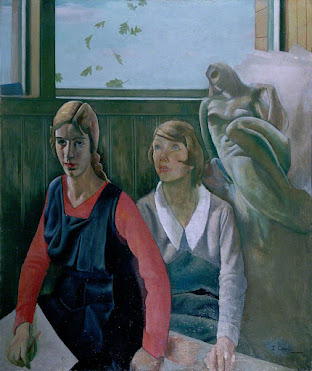
                              James Cowie, Falling Leaves, H 102 x W 86 cm, 1934,  Aberdeen Art Gallery and Museums


James Cowie (16 May 1886 – 18 April 1956) was a Scottish painter and teacher, known for his linear style and meticulous attention to composition. He originally studied English Literature at university, worked briefly as a school teacher, then quit to enroll at Glasgow School of Art  where he obtained his degree in 1914. He immediately began teaching art, though this was disrupted by the first World War. Cowie was a conscientious objector but was in the Non-Combatant Corps during the war, resuming his teaching career at the war's close.


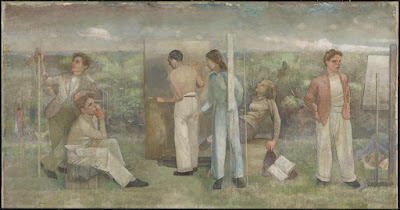
           James Cowie, An Outdoors School of Painting, 1934-41, oil on canvas, 34 x 65 inches, Tate

Cowie took an art teaching position at Hospitalfield House in the 1930's, and the painting above (considered unfinished) was from this period. Cowie was able to lead summer classes for students at this art college and art center known for its beautiful architecture and gardens, and this painting appears to be set in the grounds of the art school. Due to its large size and complex composition it was probably mainly worked on in the studio.

While the artist exhibited his work regularly in group art shows, he did not have his first solo exhibition until he was nearly 50 years old, at the Mclellan Galleries in Glasgow. He seems to have been a dedicated and sought-after art teacher, while also working consistently on his own paintings and drawings. This is a difficult balance to achieve so he deserves a lot of respect for how he managed his working life. He had many students who went on to achieve considerable notice, including Joan Eardley.

How did I hear about James Cowie? I am reading a novel by Alexander McCall Smith, The Geometry of Holding Hands, and in it two of the characters briefly discuss a painting by Cowie. Intrigued, I immediately googled the artist and realized that I'd seen some of his work in person (I spent a year living in Scotland many years ago) and also that he had created several pieces that fit the criteria of this blog! What a great find. Thank you Mr. McCall Smith!


Tuesday, September 15, 2020

Amazing Ivana!


Ivana Kobilca, self-portrait,1894-5
Image courtesy of Wikimedia


I find this self portrait by Slovenian artist Ivana Kobilca (1861-1926) to be compelling and also a bit mysterious! Beautiful strong brushwork and subtle, sure, color hit the eye, along with the engaging gaze of the artist. It looks like it was painted for fun, alla prima, perhaps as a way to use up the paint left on her palette from one of her more careful and studied studio oeuvres. One of the artist's most famous works, Summer, shows her lush Realist style, painted only 5 years previously. This is quicker, looser, more informal, lighter in tone. Seems like a very different period in the artist's development to me.  In addition, I think that in this painting  Ivana looks far older than the 33 or 34 years she would be if this piece is dated correctly. Note the gray hair at her temple? So, I'm wondering if this piece is misdated. What do you think?


Ivana Kobilca was born in Llubljna, Slovenia (the country formerly know as Yugoslavia.) She was the daughter of a wealthy and supportive family, one which placed a high importance on education.  She learned drawing from an early age and studied with artist Ida Künl. When she was 16, she accompanied her father on a business trip to Vienna; this was a transformative experience for the young artist. Inspired by the incredible art she saw there, she soon afterwards  left Slovenia to study in Vienna and Munich for about ten years.


             Another Self-portrait 1893-5  (with shadowy palette) courtesy of the National Gallery of Slovenia


Punctuated by visits home, she then traveled, lived and worked in various other European capitals, like Florence and Paris, for the greater part of her adult life. She lived for quite some time in Sarajevo, and then Berlin, and then finally returned to Ljubljana just before the First World War. At the time of her death in 1926 she was described as the greatest female painter in the country.


I wish I knew something about her personal life, but none of the articles I read say anything about it. No marriages, children or close friendships are mentioned, though we know people do not exist in a vacuum! I'm kind of annoyed by her Wikipedia page which ends the otherwise decent biography by castigating her for not changing her style to Impressionism like all the other artists were doing at the time, and also characterizes her later work as "dull." None of the images I was able to find appear dull to me...maybe it's a case of beauty being in the eye of the beholder? Also, I really dislike when artists get criticized for staying true to their inner passion and not following current trends like the rest of the sheep. Just saying... ;-) 


Ivana Kobilca is now regarded as one of the the most important Slovenian artists, male or female, of her time! She has posthumously received numerous honors, such as her portrait appearing on a Slovenian banknote:


Her life and work were also the focus of a recent major exhibition, 21 June 2018 – 10 February 2019, at the National Gallery of Slovenia. She is quoted as having said, "Painting is something beautiful..." and she seemed to have wanted to inhabit that beauty her entire life. 


Tuesday, March 13, 2018

Mysterious Michaelina

Michaelina Wautier "Self Portrait with Easel" oil on linen 1649 private collection
To be honest I'd never heard of this artist before last night! I was scrolling through some paintings online, when this beautiful image caught my eye:

Michaelina Wautier, "Saint Agnes and Saint Dorothea" oil on linen 17thC Royal Museum of Fine Arts, Antwerp
I thought it was a particularly fetching Rubens, and clicked to learn more. To my surprise it was credited to Michaelina Wautiers instead, an artist I had never heard of before. Intrigued, I did some quick research and feel compelled to share what I could dig up.

Michaelina Wautier (sometimes her last name is spelled Woutiers) was an artist from what was then called the Southern Netherlands, an area now mainly in modern day Belgium and Luxembourg. Very little is known of her life but she was active in Brussels, 1617-1689, where she lived with her brother, the artist Charles Wautier, and another painter. She was supported by art patron Archduke Leopold Wilhelm of Austria who acquired at least four of her works for his renowned art collection. Wautier painted with mastery in multiple genres, skillfully producing portraits and still-lives, as well as history and religious scenes. Her self-portrait (first image) was included in the ground-breaking Women Painters of the World, published in 1905, but it was erroneously attributed to the contemporary (but twenty years older) Baroque painter Artemisia Gentileschi. About thirty extant paintings are definitively attributed to Michaelina Wautier, who was well-known and respected during her lifetime, thus leading to a paper trail of documentation, diary mentions, sales receipts and notations about commissions etc.

Wautier will receive long overdue attention some time later this year when the first solo exhibition of her work will be held in June 2018 at the Rubens House, co-sponsored by MAS/Museum aan de Stroom, in Antwerp. Interestingly, there is an urgent International Art Search ongoing for six lost paintings by Wautier, whereabouts currently unknown, which the curator and museum are hoping to locate before this exhibit! Lots of excitement building about this talented and hitherto almost forgotten artist, Michaelina Wautier!


Thursday, February 8, 2018

A Tribute to Paula Modersohn-Becker on her Birthday

Paula Modersohn-Becker Painting in the Garden, Otto Modersohn, July 19 1901


Today is the 142nd birthday of painter Paula Modersohn-Becker (1876-1907!) She is one of my very favorite artists, which actually makes it difficult to write about her. There is so much I want to say that I have to rein myself in and sort carefully through the avalanche of  thoughts and feelings I have about her life and her work. Her work reaches out and grabs at my heart.

It is a sad fact for me that Modersohn-Becker did not seem to have created any artistic works showing herself or any other woman at work creating art or with the tools of her artistic trade close to hand. Those are my firm parameters for Women in The Act of Painting. While she portrayed women constantly and herself frequently (she was one of the first European artists, male or female, to depict herself nude) her self portraits mainly show her holding flowers or babies. And same for her portraits of other women and girls. These paintings speak eloquently to my heart, but are also a frustration for me, as the creator of the Women in the Act of Painting project. It does make me search harder, deeper and wider though, which can be part of the fun of doing this project, uncovering little known images. If anyone reading this finds a Modersohn-Becker WAP piece, a drawing, print or painting, please let me know!

I found one oil sketch of Modersohn-Becker painting, created by her husband Otto Modersohn (1865-1943), himself a really excellent painter. He was one of the co-founders of the Worpswede Artist's Colony where he and the younger Paula Becker met.  The colony was famed for its gorgeous gardens, and this painting was almost certainly painted there, probably en plein air. I don't have all the details about this piece despite hours of searching, and I'd love to know its dimensions or current location. If anyone knows, please get in touch! During their lifetimes, Otto Modersohn was by far the better known and more highly respected artist of the couple, but now his reputation is very much secondary to hers. No need to feel too sorry for the fellow however, as he does have an entire museum dedicated to his work! He is best known for his beautiful landscapes and pastoral scenes.


And, what an unalloyed thrill to see that Paula Modersohn-Becker is today's Google Doodle!  A Google Doodle is the biographical/historical image (with informational links) that decorates the Google search engine site, and which changes daily. This is the second time I've used a Google Doodle on WAP. The first time was last year's doodle celebrating the sculptor Edmonia Lewis! I was so grateful for that doodle because w/o it I didn't have a way to showcase Lewis using the WAP parameters: there are no art images of her at work. I am finding myself frequently thankful to the Google Doodle folks for their WAP help. Much appreciation to Google Doodle!

The young Paula Becker had to fight her family's expectations for her (they wanted her to become a teacher) in order to study art. While spending a summer at the Worpswede Art Colony with her friend, the sculptor Clara Westhoff (who later married Rainer Maria Rilke) Paula fell in love with the painter Otto Modersohn, a widower with a young child. They married and had a complicated relationship. Modersohn-Becker seemed afraid of becoming too enmeshed in the wifely domestic expectations of women at that time, fearing (correctly) that such would would limit her ability to do her art work. While she apparently doted on her stepdaughter and was a fond wife to Otto, she also frequently took long trips apart from the Modersohn household, studying in Paris, for instance. Her strong desire to experience pregnancy and motherhood, which can be seen in so many of her paintings, eventually led to her agree to becoming pregnant. The couple was joyful. But in a stroke of tragic irony, Paula Modersohn-Becker died of complications following the birth of her baby. She was thirty-four years old.

I urge you to read more about Paula Modersohn-Becker (there are several biographies) or simply do an image search for her work on-line. There is something so open and strong about her work. Earthy, literal, yet sublime, ineffable. Apparently simple, but actually complex. I love that combination. As a very young artist I copied a couple of paintings she did just for my own satisfaction, perhaps as a way to try and internalize some of her spirit. Maybe I will try that again! Yes, her life was cut short, but Modersohn-Becker was always trying new things and learning, and I suspect she always would have been, even had she lived a longer time. She was an explorer and and an innovator. Happy Birthday Paula!

Friday, January 19, 2018

Swooning for Swoon

Swoon, Nee Nee, 2014, Ink, Paper and Wheat paste. London.
Swoon is the nom de brosse of Caledonia Curry (b. 1977) a multi-media artist based in New York. While her projects take many different forms, she is probably most well known for her street art, in particular her series of large intricately cut paper prints which she wheat pastes to disused or empty buildings in Manhattan and Brooklyn, and around the world, too. These prints are complex portraits, depicting friends and family. Her style is inspired by many sources such as folk art, German Expressonist woodblock prints and Indonesian puppets.

The artist is deeply engaged by current events and has created work in response to Hurricane Sandy and the earthquakes in Haiti. She is one of the originators of Konbit Shelter, a sustainable building project in Haiti, and has been centrally involved in several other fascinating projects relating to both art and social issues. In 2015 Curry founded The Heliotrope Foundation.

Curry received her BFA from the Pratt Institute in New York City in 2002. She has been included in several museum shows and in 2014 had a site specific installation at the Brooklyn Museum called Submerged Motherlands. To see more of the artist's portfolio, check out her beautiful website!

Friday, January 12, 2018

Art Class and Beyond

Uranie Alphonsine Colin-Libour, The Art Class, 1891, oil on linen, 63.5 x 89 inches, private collection
Uranie Alphonsine Colin-Latour (1831 - 1916) was born in Paris. She studied with several well-known painters of the day, including François Bonvin and Charles Louis Lucien Muller, as well as sculptor François Rude.

This charming scene, entitled, The Art Class, shows an all-female atelier, which was probably how Colin-Libour started her own art education before later studying "seriously" with her male teachers. It is fun to think the intent young girl, being kindly guided by her instructress, is a self-portrait of Colin-Libour as a precociously talented child, and the more self-assured young woman making friendly eye contact with the viewer is the artist too, in a later stage of development. This is just my theory.

Colin-Libour exhibited in the art pavilion  of the Woman's Building in the Chicago World Exposition of 1893, which means she must have been held in high regard. This was an honor accorded only to the very best woman artists of the day, representing their different countries. The paintings Colin-Libour exhibited can be seen here.


Woman's Building Poster, 1893, Madeleine LeMaire
It is worth noting that the poster for this ground-breaking exhibition was designed by french artist Madeleine LeMaire, who was a fascinating person too! As well as being a talented professional artist, she held a renowned weekly salon for Parisian intellectuals and artists. LeMaire was the inspiration for the character of Madame Verdurin in Marcel Proust's seven part novel A la recherche du temps perdu (Remembrances of Things Past) published 1871-1922.

Back to Uranie Alphonsine Colin-Libour, the only other significant piece of information I have found out about her is that she is included in the important book, Women Painters of the World, published in 1905, an overview of all the prominent (European) female artists (or those deemed prominent by the editor) up to that time. This is an absolutely  seminal book for the history of art, and for the history of women's art in particular, and means that Colin-Libour had to have been considered one of the very best of the best. If only more was known about her today!

Woman Painters of the World, Walter Shaw Sparrow, 1905


Thursday, January 11, 2018

Another Thamar

Thamar painting the goddess Diana. From Boccaccio, Des cleres et nobles femmes, De claris mulieribus in an anonymous French translation c. 1400-25, French (Paris). Collection of the British Library, MS Royal 20 C V f. 90

Thamar (5th century BC) was a well-known painter in ancient Greece. There are no standard spellings of names translated from ancient tongues and so you will see this same artist also referred to as Tamar, Tamara, Thamyris, Thamaris and Timarete. Her father was the painter, Micon the Younger, and she learned the painting trade from him. In those times trades and professions were traditionally kept within families. Pliny the Elder wrote of her in his famous tome Natural History (77 CE) saying, "...she scorned the duties of women, and practised her father's art." Whether or not Thamar actually scorned anything we will never know, but she was extremely good at painting and her fame lives on, although there are no known extant examples of her work. Most painting at that time was done as fresco or mural, and the majority of architectural structures of that period have been ruined by the passage of time, or demolished, or subsumed by later renovation.

This is a 15th century rendition of Thamar, which accompanies text by Bocaccio, from his book Of Noble Women written in the early 1400's. It was a runaway "best-seller" of the times! Because so many copies were made of this book there are numerous illuminations (text illustrations) of Thamar, and as was usual at the time, the artist from ancient times was dressed in the fashion of the "present" day. In this image by an unknown French artist we see Thamar painting what was probably her best-known work, a depiction of the goddess Diana. That masterwork was famous in her day and after and was long displayed in a position of reverence at the temple of Epheseus. Unfortunately, that temple was completely destroyed in 401 A.D. by a Christian mob led by St. John Chrysostom.

For more depictions of Thamar, please look in the side bar where you will see this is one of several! Click on "Thamar" to see them all! :-)


Don't forget, to enlarge this or any WAP image for better viewing pleasure, just click on it!

Monday, January 8, 2018

Snowflake Painting

"I’m a Special Snowflake" oil on aluminum panel, 60” x 36”, 2017

Artist Alia El-Bermani has become fascinated with folded paper objects, using them as props in her paintings. She recently asked artist friends to mail her handmade paper snowflakes for this particular painting. She received hundreds of flakes from artists all over the world, some of which can be seen here. The two flakes which cover her face were made by her children several years ago and were included in another painting titled "Space Between." El-Bermani says, "In this new work my identity is somewhat obscured by their presence, but thru them I view the world more completely," referencing the exigencies and enlargement of motherhood,

Her intention is that when this painting is exhibited, the snowflakes in the painting will be installed near the piece and viewers will be asked to create their own flakes to add to the installation. The artist comments, "
This self portrait is an expression of how I often feel invisible amongst the blizzard of talent that is prevalent in our art world today, while also firmly believing in the solidity of my ability and relevance as a painter."

El-Bermani
attended the Laguna College of Art and Design and runs a teaching studio in Raleigh, NC called Alia Fine Art Studios. More info on El-Bermani's work can be found at http://alia-fineart.com/.

Wednesday, April 26, 2017

Cultural Nexus

Sandra Gonzalez, "Nuestra Pasado/Nuestra Futuro" (Our Past/ Our Future)  mural, 2017  photo: Jared Jischke
Sandra Gonzalez (b.1986) was raised in Tamaulipas, Mexico, emigrating to the United States in 2000 with her family. Her artwork springs from the intertwining of her Mexican heritage and her American culture. Her style reflects this with colorful Mexican-American patterns and symbols of both cultures. Traditional Mexican fabrics and tiles inspire her work and the artist states that she sees fabric "as a social metaphor where each garment is a collection of individual fibers forming a group/society." She feels passionately about helping communities with her art, often involving them with the painting process.

Sandra studied studio art and printmaking at Texas A & M University and received her MFA in 2013 from the Pennsylvania Academy of the Fine Arts. Full disclosure: Sandra was one of my classmates and friends in the MFA program at PAFA! I always loved Sandra and her work, and so I was thrilled to discover she'd recently created a piece I could include in my Women in the Act of Painting project! After graduating from PAFA Sandra was hired by Philadelphia Mural Arts where she became enthralled with the whole concept of mural painting. In particular she was inspired by mural artist Betsy Casañas with whom she has worked on several projects.


Eventually returning to her home state of Texas, Sandra now works as a High School art teacher and continues to create public art large and small. She's completed several mural projects in the past few years, unifying neighbors, friends, students and families who work together on her projects. 


This particular piece (shown above) was part of the Electrical Box Project commissioned by the Marina Arts District and completed in January of 2017. The box is located at Mesquite & Williams Street in Corpus Christi, Texas. The box is covered with the bright colors of embroidered flowers, and tiles. One side features the artist's beloved grandmother, and the other side (pictured) shows her young niece, Kira, in the act of painting. "I have always been inspired by the women in my family." Sandra says.  The juxtaposition of age and youth explain the work's title, "Nuestra Pasado/Nuestra Futuro" which translates as Our Past/Our Future.  While I don't usually use photos in this blog that display anything but the artwork itself, this charming shot of Sandra's niece jubilantly playing her violin next to the mural bearing her likeness was simply too charming to pass up! So, since I'm on a roll, here's another, of Sandra showing the other side of the box mural. 


Sandra Gonzalez, "Nuestra Pasado/Nuestra Futuro" (other side) mural, 2017  photo of the artist: Earl Parr

Sandra Gonzalez's website can be found here. More up-to-the-minute photos of the artist's work can be seen on her colorful Instagram account.

Wednesday, February 1, 2017

The extraordinary Edmonia Lewis

Doodle by Sophie Diao

I'm absolutely thrilled to find that today's Google Doodle depicts Edmonia Lewis! I have long had my eye on Ms. Lewis for this Women in the Act project, but was never able to find an artwork depicting her at work. Frustrating! Now at last, I'm able to feature this outstanding artist.

Edmonia Lewis (1844 - 1907) was the first American woman of African American and Native American heritage to achieve international fame as a sculptor. Lewis pioneered a unique style which incorporated African American and Native American cultural themes into her Neoclassical style sculpture. Her independent and adventurous life at a time when women's lives were routinely limited was likewise avant-garde, unique and awe-inspiring.


Lewis was born in New York state to a father of Haitian descent and a mother of Mississauga Ojibwe and African American descent. After her parents’ death when she was nine years old Lewis was adopted by her maternal aunts, who supported the family by crafting and selling Ojibwe baskets and other souvenirs for tourists. Interestingly, at this period of her life Lewis went by her Native American name, Wildfire.  At age 15, Lewis enrolled in Oberlin College, and began her serious study of art. Unfortunately her time at Oberlin was fraught with disruption and outright discrimination. Because of certain charges brought against her (later dismissed) she was prevented from enrolling in her final term, and therefore was unable to receive her degree.

Undaunted, Lewis moved to Boston in 1864, determined to pursue a career as a sculptor. She apprenticed with Edward A. Brackett, a sculptor whose clients included many well-known abolitionists. Lewis worked as Brackett's apprentice until 1864, when she launched her first solo exhibition, which paid homage to the abolitionists and Civil War heroes of the day, including John Brown. Her work became very popular and her financial success allowed her to travel to Italy to further pursue her studies. "I thought I knew everything when I came to Rome, but I soon found I had everything to learn.” Edmonia Lewis (quoted in Romare Bearden's, A History of African-American Artists)


In Rome, Lewis soon joined a circle of expatriate artists and established her own studio. She began sculpting in marble, combining classicism with naturalistic observation and themes relating to African American and Native American people. Her work won respect and fame, and commanded large sums of money. She continued to receive international acclaim until her death in 1911.

Today’s Doodle depicts Lewis sculpting one of her most famous works, The Death of Cleopatra, which is on display at the Smithsonian American Art Museum in Washington, D.C. Her strong yet sensitively realized  portrayal of Cleopatra’s death received the highest praise from critics when it was exhibited at the 1876 Centennial Exposition in Philadelphia. One called it “the most remarkable piece of sculpture in the American section" of the show. 

The artist Sophie Diao who created the Edmonia Lewis Doodle works at Google and freelances for the computer animation industry. She graduated from the California Institute of the Arts in 2013. Her impressive portfolio can be seen here!

Self-Portrait with dog, Sophie Diao


Saturday, December 10, 2016

The Amazing Pan Yuliang

Pan Yuliang "Self Portrait" oil on canvas 1924 Private Collection
Pan Yuliang 潘玉良 (1899-1977) is famous as one of the first Chinese artists with a successful career in "Western Style" painting. She was born Zhang Yuliang 張玉良 in Jiangsu Province on the Eastern Coast of the People's Republic of China, where it borders the Yellow Sea. Yuliang's parents died when she was 14, and her uncle sold her to a brothel.

She caught the attention of a wealthy customs official, Pan Zanha, who purchased her freedom from the brothel and married her as his second wife. He also ensured that she received an education. The family moved to Shanghai in 1920 and Yuliang was accepted into a Shanghai Art College. Shanghai was notable for Haipai, or East Meets West style, and Shanghai artists were open to all kinds of current trends, not focused solely on traditional Chinese culture. After graduation, Zanha sponsored Yuliang's further study in France and in 1925 she won a scholarship to study in Rome. In 1926 she won a major art prize in Rome, and a few years later, she returned to China to exhibit and teach. She had five solo exhibitions from 1929-1936 and taught in Shanghai and also at National Central University in Nanking.


Pan Yuliang "My Family" oil on canvas 1931-32 source: Self-Portraits of Color

Although her work was popular with Chinese audiences at the time, it was also criticized by the government as being too Western. In 1937 she sailed for France again, settling in Paris where she lived and worked the rest of her life. During her career she was on the faculty of the École des Beaux Arts and elected as the Chairman of the Chinese Art Association. Her work was exhibited widely and she won many prestigious prizes. She died at age 78 and is buried in Montparnasse Cemetery in Paris.

Her fascinating and colorful life is the subject of film and literature, the most recent being a fictionalized biography, The Painter from Shanghai, by Jennifer Cody Epstein (2008.) Much of Yiulang's work was returned to China after her death and is held by various national museums and cultural associations there. 


Tuesday, February 16, 2016

Studio Air

Emma Amos, Studio Air, acrylic on linen canvas with African fabric borders, 72″ × 61″, 2003
Emma Amos (b.1938) has always been fascinated with fabric, even to the point of weaving her own painting cloth for a time in the nineteen sixties. Her paintings often incorporate distinctively patterned African fabrics as borders which relate in various ways to the central images. Ms. Amos has said of her own work, "I like that people can read their own meanings into my paintings and that those readings may be quite different from mine." This fascinating and many-layered painting, incorporating a self-portrait, definitely sparks off many possible story lines in the viewer's mind.

Georgia-born and raised, Emma Amos has studied and worked in numerous states and countries, but has been based mainly in New York City since the nineteen sixties.  The artist began teaching at Rutgers University in 1980, receiving tenure in 1992 and continuing to teach there until her retirement from academia  in 2008. She has received many honors and fellowships, including the Pollock-Krasner Grant and a Yaddo Artist Residency. Her most recent honor is the Georgia Museum of Art's 2016 Larry D. and Brenda A. Thompson Award, for "her contribution to visual art in Georgia." Her work is in the collection of that museum as well as many others, including the Library of Congress (USA), the National Gallery of Art (USA)  and the Pennsylvania Academy of the Fine Arts, as well as numerous other public and private collections world-wide. She maintains an active studio practice and is represented by Flomenhaft Gallery in NYC. The artist's beautiful website can be seen here.

Friday, January 29, 2016

Dragon Painter

Totoya Hokkei Woman Painting a Dragon woodblock print ca. 1832 

This beautiful image is a print, so multiple copies of it exist in various locations, including the Denver Art Museum and the Harvard Art Museum here in the states. I don't know if the painting is illustrating a particular tale or poem or if it is just a fanciful invention. The dragon the artist is painting floats up off the paper, which is certainly the way it feels when an artist is deep into the act of creating.

Totoya Hokkei (1780-1850), was a prolific and successful Japanese artist who worked in numerous genres. He started off life as a fishmonger before turning to painting, eventually becoming one of the great Katsushika Hokusai's first students. Hokkei is best known for his work in the ukiyo-e style depicting the "floating world" of courtesans, actors, theatricals and other aspects of the urban pleasure districts which flourished during the prosperous Edo period. 

Thursday, January 28, 2016

Lluïsa who "Paints Like a Man"

Lluïsa Vidal i Puig Self Portrait 1899

Lluïsa Vidal i Puig (1876-1918) was a Catalan painter from Barcelona. One of twelve children she first studied with her father, Francesc Vidal i Jevellí, who, similar to William Morris in England, was a designer and craftsman deeply involved in the art world. When Lluïsa was sixteen she visited The Prado in Madrid, and was inspired by the works of such great Spanish artists as Diego Velazquez and Francisco Goya.
She began exhibiting her work professionally in 1898 at age 22, and in 1901 she left to study further in Paris. While in that city she became a supporter of the Feminist movement, which she learned about in part through through the ground-breaking French Feminist newspaper called La Fronde. (It's actually kind of amazing, click on the link to learn more!) She left Paris to study for a short time in England.
Lluïsa returned to Barcelona in 1902 at the request of her family,cutting short her study abroad because three of her sisters had fallen ill and her help was needed. To assist the family financially she began giving private art lessons and also worked as an illustrator for Feminal Magazine, a Spanish Feminist publication. She painted and exhibited tirelessly despite the many calls on her time. "Critics, all of whom were male, were awed as well as stumped, using words such as 'Virile" to describe her talent. In surprised admiration, they would write: "She paints so well... she paints like a man!" ("Painted Like a Man, Disappeared like a Woman: Luisa Vidal, The Daughter of Modernism" by Marcy Rudo, OTI, 1998.) She had a major exhibit at la Sala Parés, an important art gallery in Barcelona in 1914, receiving rave reviews and accolades. Unfortunately she died only a few years later, during a Spanish Flu epidemic epidemic in 1918. Despite her burgeoning fame and the critical acclaim she received during her lifetime, after her death her name sank into obscurity. Now rediscovered, she is considered part of Modernisme, the Catalan modernist art movement.
Lluïsa Vidal i Puig Self Portrait Date unknown
note: Lluïsa Vidal i Puig's name follows Spanish naming customs: the first or paternal family name is Vidal and the second or maternal family name is Puig. She is often most easily searched by using her patronymic, Vidal, rather than Puig.
P.S. Many thanks to my old friend, writer Elizabeth Castro for her kind assistance in finding out more about this wonderful Catalan artist!