Thursday, January 31, 2013

Subject and Verb


Berthe Morisot "Self-Portrait"  1885  Musée Marmottan Monet
Berthe Morisot  (1841-1895) was one of the founders of the Impressionist movement. She showed artistic promise from childhood on and at age twenty-three a painting of hers was chosen for the highly selective Salon de Paris. She exhibited in six subsequent Salons until 1874 when she threw in her lot with like-minded art colleagues who (unlike herself) had been rejected by the official salon jury, and the group initiated the first impressionist exhibition. The rest is, of course, history. Morisot is often referred to as one of "les trois grandes dames de l'Impressionnisme" along with Marie Braquemond and Mary Cassatt. Morisot's skill was prodigious and seemed to be forever evolving in both subtlety and directness. On the occasion of the eighth and last Impressionist Exhbition in 1886 critic Jean Ajalbert said this about Morisot's technique, ``She eliminates cumbersome epithets and heavy adverbs in her terse sentence. Everything is subject and verb."

Morisot was one of three painting sisters, all raised in a comfortable and cultured french family who were unusually supportive of the young women's artistic ambitions. I have written about Berthe's close relationship with her sister Edma, but the oldest sister Yves, also displayed unusual talent for art, although she very early abandoned it as a serious pursuit. Yves' daughter Paule Gobillard (1867-1946) inherited both talent and ambition. She was often to be found working with Morisot in her home and studio. Indeed, when Yves Gobillard died in 1893 Paule and her younger sister Jeanne moved in for a time with their aunt Berthe and their cousin Julie Manet. Morisot's husband Eugène Manet had died the previous year and the doubly bereaved women drew together for mutual support and comfort.

Berthe Morisot "Paule Gobillard Drawing"  1886 Private Collection
Interestingly, both these portraits of Gobillard are dated 1886. In the first Gobillard's hair is still down her back in a childlike braid, whereas by the next piece she was wearing it up, a sign of maturity. Hair up or down could be of social significance or simply illustrate a random moment, perhaps a morning when the girl had not had time to dress her hair properly in her eagerness to get to the drawing board! 


Berthe Morisot "Paule Gobillard Painting"  1886  Musée Marmottan Monet

Paule Gobillard never married, but remained close to her sister Jeanne and her cousin Julie Manet, and was involved in the family life of her relatives. She continued to paint throughout her life and exhibited regularly at the Salon, as well as at private galleries in France and abroad.

Wednesday, January 30, 2013

Frank Herbert Mason

Frank Herbert Mason "The Art Students" 1983


Frank Herbert Mason (1921-2009) had an illustrious and industrious career as an artist, teacher, art conservator and arts activist. Born in Cleveland, at age sixteen he was offered a scholarship to attend The Art Student's League of New York, where he studied closely with Frank DuMond, eventually taking over his teacher's position upon DuMond's retirement. Mason, by all accounts an immensely gifted and beloved teacher, taught for over fifty years at The Art Student's League and also led summer classes in Vermont. He was one of the founders of ArtWatch International, which monitors conservation of great masterpieces and lobbies for better conservation practices generally. At some point in his career Mason moved to Europe for several years where he received commissions and awards for his work, even receiving the Order of Malta. His work is in many public and private collections including the Hermitage Museum in St. Petersburg and The Museum of the City of New York. A documentary film about the artist-teacher-conservator, A Light in the Dark, premiered in 2011.

This painting shows Mason's studio and two of his art students, Elizabeth Torak (left) and Erika Howard Dolmans (right.)  Dolmans says of this piece, "Lizzie and I had a lot of fun posing for this one! The mornings were cold in Frank's studio, though! I miss him."

Mason's official website can be seen here.

Tuesday, January 29, 2013

Pompeian Painter

artist unknown "Pompeian Woman Painting" ca. 55-79 a.d.
The National Archeological Museum of Naples, Italy
This fresco panel taken from the ruined city of Pompeii goes by many different names, with the most simple and elegant being the Italian title of "La Pittrice." It shows a seated woman painting, or perhaps applying just some finishing touches to a piece which appears to be already framed and held by a young boy. The artist is looking at a painted statue which is said to be of Priapus (for reasons which become clear if you click on the image and view it enlarged.) However, the God of Fertility is missing one of his usual attributes, a large peaked Phrygian cap. Two women look on as the painter works.  It is interesting to note that the painter has arranged herself so that the light falls from her left, as is still the norm for right-handed painters. A bit of a mystery is that the painting held by the child appears to be translucent...we can clearly see the shadow of his form through the piece, unless it is just a dark stroke that happens to look like this.

We know that women worked as professional painters, sculptors, potters, jewelers and etc. in ancient times. As in most professions throughout history, people tended to do the same work as their families, so that most female artists and artisans we hear about were trained in family workshops.

Monday, January 28, 2013

iphone self portrait

Mia Robinson "Self-Portrait as Paula Rego"  2009

Mia Robinson (b.1979) is one of the growing number of artists using digital apps as a way of creating their artwork. This piece was sketched after the artist spent time poring over the artwork of Portuguese-English artist Paula Rego...and something in the alertness, strength and almost confrontational aspect of the pose does hint at that artist's unique "flavor." Robinson, currently based in  Washington, D.C., has exhibited her work internationally. Her website can be found here.

Sunday, January 27, 2013

E de K

Elaine de Kooning "Self-Portrait"  1946
 National Portrait Gallery, Smithsonian Institution, Washington, D.C.  
Elaine de Kooning (1918-1989) was born in Brooklyn, New York. She attended Hunter College, the Leonardo da Vinci Art School and the American Artist's School in NYC. De Kooning was a talented and prolific artist but her marriage to the massively influential painter Willem de Kooning both brought her to national attention and somewhat"sidelined" or "ladies auxiliary-ed" her career.  She was nonetheless a highly respected artist, portraitist, teacher and critic in her own right. She is often quoted as saying, "A painting to me is primarily a verb, not a noun, an event first and only secondarily an image." De Kooning's work is in the collection of MOMA, the Metropolitan Museum of Art, The Pennsylvania Academy of the Fine Arts and the Whitney Museum as well as many other major art institutions.  

Saturday, January 26, 2013

Huntington


Daniel Huntington "Italy" 1843  National Museum  of American Art, Washington D.C.

Daniel Huntington (1816-1906) was born in New York City. He attended Yale University and Hamilton College, studying with F.B. Morse and others who later founded the National Academy of Design. Huntington became a fellow of that organization in 1839 and a full Academician in 1840. The artist traveled extensively in Europe, which he found inspiring. Another locale where he found a lot of subject matter for his work was in the White Mountain area of New Hampshire. Although he lived in New York City, for many years he shared a studio in Jackson, New Hampshire with a group of similar-minded artists that included Asher Durand and Aaron Shattuck.

Daniel Huntington "The Sketcher: a Portrait of Mlle. Rosina, a Jewess" 1858
The Brooklyn Museum, NYC

Huntington seems to have been by all accounts an intelligent, sincere and pleasant person who was esteemed and respected by the majority of his peers. He was twice elected president of the National Academy of Design and he was also the vice president of the Metropolitan Museum of Art for thirty-three years. He died at age 90 after a long career of travel, painting and leadership.


Daniel Huntington "Philosophy and Christian Art" 1868
Los Angeles County Museum of Art, California


Friday, January 25, 2013

Three Generations

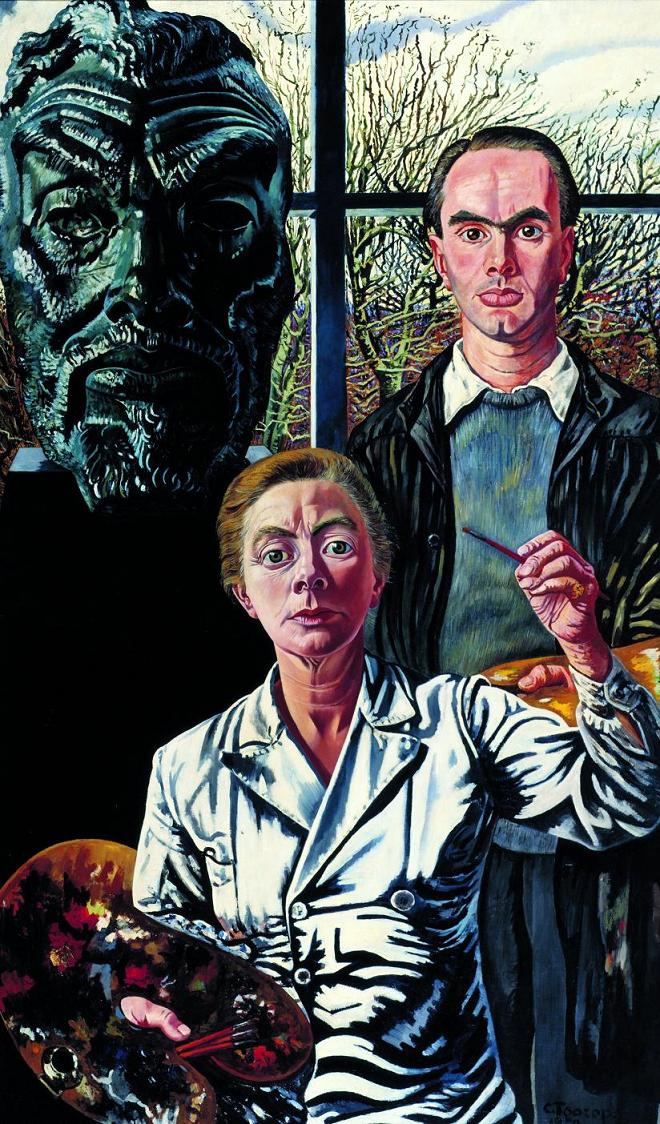
Charley Toorop "Self-Portrait with Son and Father" aka "The Three Generations"
1945-50  Museum Boijmans Van Beuningen, Rotterdam, Holland

Dutch painter Charley Toorop (1891-1955) was a member of the artist's group "The Signal" which aimed at expressing a deep sense of reality through the use of strong contrast, accentuated lines and intense coloration. It was a style of painting based on a philosophy that is sometimes called "moral realism."  Toorop believed that art had a moral responsibility to human life "...and that the human condition was an esthetic condition, for it involved imaginative wonder at the givenness of life. Without such imaginative wonder life seemed peculiarly unreal, inconsequential, and banal, and we remain humanly incomplete. For...Toorop the task of art was to awaken this wonder ..."realize" the wonder in the inevitable facts of life, and thus the wonder of our own all too human lives." (Donald Kuspit.) 

Toorop was the daughter of Javanese-Dutch artist Jan Toorop and the mother of three children including painter Edgar Fernhout (1912-1974). In this painting Toorop immortalizes the three generations of artists, with a portrait set in her studio in Bergen. She and her son hold their palettes. Her late father is represented by the inclusion of a large portrait head sculpted by John Raedecker (1885-1956) Interestingly, Edgar Fernhout's son Rik Fernhout (b.1959) is also an artist...so in fact a newer version of this family piece could incorporate four generations. In addition, Toorop's other son John Fernhout was a filmmaker.  That was some very strong art gene passed down from Great-Grandfather Jan!


This painting was an instant visual "hit". In 1950, not long after its completion,  Toorop's daughter-in-law the well-known Hungarian photographer Eva Besnyö (1910-2003) took a shot of the artist in front of what has since become one of the most iconic Toorop pieces. 

For the previous WAP post on Charley Toorop click here.