Tuesday, November 27, 2012

Showing her Teeth

Louise-Élisabeth Vigée-Lebrun  "Self-Portrait in a Straw Hat" 1782
 National Gallery, London, England 

I cannot really say anything that will add much to the the towering presence that is Louise-Élisabeth Vigée-Lebrun. She was one of the foremost artists of her day, and is considered one of the foremost women artists of all time. In her lifetime which spanned from 1755-1842 she completed over 600 works of art. She painted masterfully in all genres but was most noted for her portraits.

Louise-Élisabeth Vigée-Lebrun  "Self-Portrait" 1790
Galleria degli Uffizi, Florence, Italy
In 1787, she caused a minor public scandal by exhibiting a self-portrait in which she is shown smiling with her mouth slightly parted, in shocking disregard of painting conventions stretching back to antiquity. This painting may have been her "Madame Vigée-Lebrun et sa Fille" (1786). The court gossip-sheet Mémoires secrets commented: ‘An affectation which artists, art-lovers and persons of taste have been united in condemning, and which finds no precedent among the Ancients, is that in smiling [Madame Vigée-Lebrun] shows her teeth.’ Vigée-Lebrun ignored the scandal and what is more, continued to flagrantly show her teeth, as we can see in the above painting from 1790. 

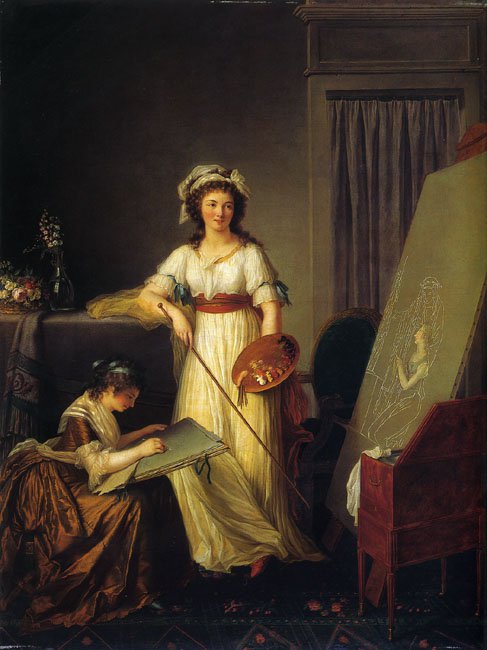
Marie-Victoire Lemoine "The Interior of an Atelier of a Woman Painter"
1796  The Metropolitan Museum of Art, NYC
Like most artists, Vigée-Lebrun also taught the craft of painting, and was a popular instructor. This painting is a tribute to Vigée-Lebrun by one of her former pupils, Marie-Victoire Lemoine (1754–1820.) It is thought to depict Vigée-Lebrun as instructress and Lemoine as pupil. if so, the difference in size of the two artists possibly is intended to convey Lemoine's humble perception of their relative artistic statures rather than any actual height difference. In 1796 Vigée-Lebrun had fled France and was living in St. Petersburg, this change necessitated by the French Revolution and her known royalist sympathies.  Lemoine loyally attempted to keep alive in France the memory of her former teacher with this touching, if slightly veiled, homage


Monday, November 26, 2012

Self Portrait

Enjeong Noh  "Self-Portrait"  2001

Enjeong Noh is a contemporary painter based in California. Originally from Korea, where she received a B.A. in Literature from Seoul National University in 1992, Noh came to the U.S. to study at the Art Center College of Design, Pasadena, California. She is represented by the Lora Schlesinger Gallery in Santa Monica, California.

Noh paints still life and figure, and her work in both genres blends similar elements of representation and symbolism. She has said of her aesthetic impulse, "I am a female voyeur. With the intertwined psychological milieu of Asia and America, and art and literature, that shapes my thinking, I endeavor to portray the mystery and complexity of being."

Sunday, November 25, 2012

Painting with Baby

Karen Winslow  "Self-Portrait with Daughter Annie"  1988
Karen Winslow is one hardcore mother-artist. While many of us will admit to the occasional quick session at the easel with a dozing toddler on our laps, very few people I know have done any painting standing at the easel with fully awake baby on the hip. Winslow, a contemporary oil painter based in Vermont, gets the Mother's Medal of Heroic Painting for this feat.  Winslow herself says of this piece, "This was painted in 1988, and my Annie is now married with kids of her own."


Katy Schneider  "Self Portrait with Olive and Easel"   1998
Katy Schneider also must be awarded the same prize for painting with baby in arms. Schneider is a contemporary painter based in Massachusetts whose work is concerned mainly with scenes of her own domestic life.  The mother of three children Schneider's small oil paintings are like amazing little snapshots in oil paint of her growing children and evolving family relationships. While Schneider's paintings show the particulars of her own life they somehow go beyond the individual and tap into a more universal consciousness of what contemporary life feels like to those experiencing it. 

Saturday, November 24, 2012

Thamar with Apprentice

artist unknown "Thamar Painting, with Apprentice"  ca. 1403
Bibliothèque nationale de France
Thamar, also known as Tamar and Thamyris and Timarete, is not a myth or a legend, but was a real person, a Greek painter who lived in the 5th century B.C. In those days, people commonly followed in the trade or practice of their parents and Thamar was the daughter of Micon the Younger of Athens, a well-known and respected painter.  She was one of six women artists mentioned by Pliny the Elder in his Natural History compendium. Of Thamar Pliny says, "she scorned the duties of women and practised her father's art."  She was best known in Pliny's time for a panel painting of the Goddess Diana (Artemis) which was displayed in the Goddess's temple at Epheseus. Unfortunately, the temple, along with Thamar's work, was destroyed in either a Goth invasion in the Third Century or  by an anti-pagan mob led by Saint John Chrysostom in the 400s A.D. (Historians disagree on who gets the credit for the destruction.)

This painting of Thamar at work is from Bocaccio's De Cleres et Nobles Femmes, an edition made specially for Philip the Bold in around 1403. It is fascinating and delightful on several counts, particularly: 

1) Thamar's clothing and setting have been modernized into that of an early 15th Century French woman. This "updating" is typical practice for medieval artists. Also contemporary to the times is her painting equipment, including the presence of an apprentice busily grinding pigment (looks like lapis lazuli) for his Mistress. If Thamar did indeed scorn the duties of women, this is probably not her son, in typical Greek family workshop tradition, but instead may depict an apprentice contracted in the more typical medieval fashion through a guild. Women artists did belong to some medieval guilds and did indeed take on apprentices and journeymen, just as their male contemporaries did, although very often a female "master" was attached in some way (even just nominally) to a male, either a Husband, Father or Uncle. Still, such an arrangement was not at all uncommon, and the unknown artist making this painting would have "placed" Thamar in the terms of his/her own times.

2) Thamar has been Christianized as well as modernized. Instead of the pagan goddess Diana, or other Greco/Roman deity, we see Thamar painting a Virgin and Child. Ironic, considering Thamar's renunciation of traditional female roles! But very charming.

Friday, November 23, 2012

Lively Lovely Laura

Laura Knight  "Self-Portrait" 1913  Museum of New Zealand Te Papa Tongarewa, New Zealand
Every painting and photograph I've seen of artist Laura Knight makes me think she must have been a fun and companionable person. She definitely had a warm and playful sense of humor that sneaks into many of her pieces

Knight (1877-1970) was quite an "envelope pusher" right from her earliest days.  Born in England, she survived abandonment by her father as an infant and the death of her mother as a pre-adolescent. By lying to the authorities about how old she was she assumed the care of her remaining sibling, providing for her decimated family of two by teaching art and doing odd jobs.  It is not clear how, but she eventually managed to attend the Nottingham School of Art, where despite her rocky start in life she was still one of the youngest students ever to enroll. Other "firsts": Knight was the first woman artist to be made a Dame of the British Empire (1929), and the first woman elected to to the Royal Academy (1936.) She was also the first woman artist to be honored with a retrospective at the (notoriously hidebound) Royal Academy (in 1965.) Another "out of the box" achievement for this good-natured go-getter was her being appointed an official War Artist for the British War Office, during WW2. In this role she she was one of only three British women war artists who travelled abroad. After the war she served as Britain's official artist at the Nuremberg Trials of Nazi war criminals. An example of her trial work is The Dock, Nuremberg (1946.)


Alfred Munnings "Dame Laura Knight, Painting" Norwich Castle Museum and Art Gallery, England 

This action portrait was painted by Alfred Munnings (1878-1959) and I suspect the title of the piece was later amended to include the honor Knight received in 1929.  Because although the piece is undated, from Knight's hairstyle and manner of dress alone, I propose that it can be dated around 1910-18, especially as this was also during the period the Knight and her husband were part of an art colony in Cornwall, that included Munnings. (This was a fertile period artistically and important to all the many participating artists, who later came to be called The Newlyn School.

Laura Knight was known to look up to and admire Munnings. She later described her friend with these words, " His extraordinary vitality, his joy in his work, none of us could forget him. He was a fighter. He fought the wind that shivered his easel and canvas. He fought the heat and cold. He fought the shifting sun and the changing shadows."  The two artists shared a strong aesthetic and a similar joie de vivre. They would often go out painting together while in Cornwall. While the friendship was entirely platonic, it was a source of jealousy and ire for Knight's husband, Harold Knight (1874-1961.)  In fact, in a fascinating bit of Art History Sleuthing, in 2009 a portrait of Munnings made by Henry Knight around 1911 was found carefully concealed beneath another canvas, of Laura Knight's! It is conjectured that Harold Knight disposed of the painting he did of Munnings, whom he came to despise and dislike, and that Laura Knight rescued it and concealed it beneath a blank canvas that she later painted on. It sounds like a dramatic  device in a made for TV movie but it is true and you can read a more detailed account here.


Harold Knight  "Sir Alfred Munnings Reading Aloud" 1911
 current location unknown

Knight died at age 92, apparently still full of beans and painting very close to the end. She painted over 250 major oil paintings in her lifetime, and was one of the rare and lucky artists who received well-deserved recognition and appreciation both during her lifetime and afterwards!

Thursday, November 22, 2012

The Paintbrush


Katherine Stone "The Paintbrush (Self-Portrait)" 2008
Katherine Stone was born in Maine to Canadian parents and has dual US-Canadian citizenship. She currently lives on Vancouver Island with her husband, the painter David Gluck. Stone recently posted this essay on the couple's shared blog Painting Stuff to Look Like Stuff
Why I love being married to an artist  1.  They share your artist flakiness.  "You forgot to make dinner reservations?  Perfect!  I forgot it was our anniversary." .... 3.  They think it's a BRILLIANT idea to buy that viking helmet off of ebay, and by the way, they saw a whale harpoon at the flea market and they bought it for you ...

The artist has a keen sense of humor, but a very serious commitment to her vocation.  This evocative self-portrait contains some text in the background in what appears to be Elizabethan secretary hand, the first stanza of a poem by Emily Dickinson:

I asked no other thing,
No other was denied.
I offered Being for it;
The mighty merchant smiled.
Stone says, "I interpret the poem as being about making a bargain with fate. Offering your all in exchange for the one thing you want. In my case, painting." 
Stone has received numerous awards for her work from such organizations as the Art Renewal Center and the Portrait Society of America.She is represented by the M Gallery of Fine Art in Charleston, SC.

Tuesday, November 20, 2012

Art Class

William H. Johnson  "Art Class" ca. 1939-40
Luce Foundation Center for American Art
This was painted when William Henry Johnson (1901-1970) was teaching art classes in a Harlem community center funded by New Deal initiatives such as the WPA. To me, it's a beautiful  example of the very cusp of the artist's most mature style, when his work was segueing from expressionism into what he is now most known for, his "folk" style. I think this piece with its deliberately primitive or "faux naive" look is just emerging from the German Expressionist influence of artists like Kirchner and Muellerevolving into Johnson's own very unique visual language.

Having taught night classes myself I can attest to how perfectly Johnson has caught the bodily weariness yet spiritual eagerness of the night student.

Johnson was born in South Carolina but left his home to study at the National Academy of Design in New York City. Despite his acknowledged talent, Johnson was passed over for a traveling scholarship and his teacher Charles Hawthorne personally funded the young artist for a study tour of Europe. This act of faith had a profound effect on Johnson, who remained working in Europe for over half his career, where he had great success and exhibited widely. He returned to the US in the 1930s with his Danish wife, the textile designer Holcha Krake, where he continued his vibrant career of teaching and painting and exhibiting.  His wife died in 1944 and this sent Johnson heading back to Europe for a time to be with her family, but he returned to the US after falling seriously ill in 1947. He entered the State Hospital at Islip, New York where he remained for the rest of his life. Sadly, his illness precluded his painting after 1956.

 I'll end by quoting directly from the website of the William H. Johnson Foundation for the Arts, "This is merely the brief summary of a life marked by great happiness and great tragedy..."